|
|||||||||||||||||||||||||
| |||||||||||||||||||||||||
In this issue:
PonderingsLearning to Laugh at Yourself by Amy FriesVice President Joe Biden strides to the podium, grasps it firmly and says to the crowd: "How do you tell Joe Biden from a room full of secret service agents? He's the stiff one." The audience laughs. Mission accomplished. By poking fun at himself, the vice president was able to break the ice with the audience and contradict critics who see him as too serious. Laughter is a good social tool—it can ease tense situations and improve relationships. But the benefits don't stop there. It's well known that the sheer physical act of laughing—even when you fake it—can improve mental and physical health. Studies at Stanford University, for example, have found that a two minute belly laugh is equal to ten minutes on a rowing machine in terms of boosting your heart rate. A good laugh also:
Get a sense of humor When you were a child, experts estimate that you probably laughed 400 times a day. Now you're lucky to manage 15 chuckles. But you don't have to "be funny" to get the benefits of an increased sense of humor. You can learn to laugh at yourself, laugh more often and see the humor in everyday situations. Try the following:
It's OK to fake it If you can't find something funny to laugh about, then fake it, say humor therapists. Your body can't tell the difference between a fake laugh and a real one and in most cases, you'll end up laughing naturally. If you can't laugh, then smile. According to the "Facial Feedback" theory, a person who forces a smile soon begins to experience the pleasurable feelings associated with that expression. Amy Fries Informational Tele-Seminars & WebinarsCoaching Forum CallJoin Pat Williams as he interviews Stephen Haines and Gary Bonalumi from the Haines Centre for Strategic Management as they discuss their Systems Thinking Approach® to Coaching™ (STAC), a research-based best practices application to coaching. STAC™ is a tailored approach to developing and refining leadership and management skills and your strategic life plans. The New Paradigm Shift in Addiction-Recovery CoachingJoin Helga Genannt Matzko, ILCT faculty member, as she shares with you a comprehensive, respectful, non-judgmental, transformative and proven approach to work with recovering clients, which views addiction/recovery from a positive, life-affirming strengths and value-based perspective with really fascinating, positive results. You will become familiar with:
Date: Thursday, May 17th, 2012 4 Marketing Mistakes That are Costing you Money!Do you spend time working with unavailable web designers who aren't familiar with the coaching industry or how to reach your target market? Are you spending money on a website that's not bringing you clients? Are you wasting time and money on ineffective marketing? Join Greer Van Dyck, Online Marketing Expert of CoachingWebsites.com, for this webinar and you will get up to speed on what the biggest online marketing trends are today, and the things you MUST know for your practice to make it in this changing technological landscape. Date: Wednesday, May 23rd, 2012 How To Equip Yourself To Sell Coaching With EaseHave you always felt at a disadvantage because selling does not come easy to you? In fact, have you always felt that your coaching business would be awesome if you just didn't have to sell? Many have suggested that the skills required to be a great coach are simply at odds with the skills required to be a great salesperson. Don't you wish it could be easier? The inability to sell coaching services is the biggest setback for most coaches and is the number one cause of drop out. Most coaches love coaching, but they hate the process of having to find prospects and convince them to spend money. The need to sell causes anxiety and burnout for so many coaches and is the primary reason that so few coaches are able to make a full time living out of coaching. The truth of the matter is that … selling is not exclusively for people with the right 'personality'. Sales is for people who are fully equipped to make a sale. It's really as simple as that and it's something that every coach needs to know. Join ILCT's Director of Practice Development Dr. Sabrina Schleicher’s discussion with Kim Ades, President and Founder of JournalEngine. Here is what you'll learn:
Date: Thursday, May 24th, 2012 NewsMarket your practice with a free electronic newsletter for your clients with this 3 month trial offer!The Institute for Life Coach Training's publishing partner, WorkLife Media, has developed a new product line designed with you, the Helping Professional, in mind. To help market your practice and build client loyalty, we'd like to offer a 3 month trial of our WellDirections newsletter absolutely free! The WellDirections Newsletter is a full color monthly electronic newsletter designed to help your clients on their path to wellness. You'll receive three issues in electronic format that can be customized with your contact information and sent directly to your clients. The newsletter can be emailed to your clients, posted to your website, or even distributed in print fromat. To find out more, or to receive your free issues, visit our website. Sign up for our free Coaches Community!If you are not currently in a class, but want access to the materials from the legacy Student Lounge, or want to be a part of this fast growing group sharing resources and discussions on issues relevant to coaches, all you need to do is click here to set up your profile and get involved. ILCT partners with The Haines Centre for Strategic Management on a new courseThe Haines Centre for Strategic Management Center was founded in 1990 because its founder, Stephen Haines, wanted to make a difference in people's lives. Today, they have partners and offices in over 25 countries and have helped thousands of organizations in diverse industries and sectors create and successfully implement strategic plans. Their consulting approach improves not only the bottom-line profits but also corporate culture and work environment. "Stephen Haines is the world's foremost authority on the Systems Thinking Approach to the field of Strategic Management", said ILCT Founder Patrick Williams, "and we are thrilled to be able to partner with The Haines Centre to offer the Certificate in the Systems Thinking Approach® to Coaching™ (STAC™) course this summer." Particularly suited to existing or aspiring executive, leadership, and management coaches, this 20 hour course is part of ILCT's Business Coaching Specialist track. To learn more about the course, please visit our website. Did you miss Pat William's question and answer session during last month's Coaching Forum Call?Listen to a recording of this tele-seminar for free in our archives. Did you miss ILCT's Director of Practice Development Dr. Sabrina Schleicher’s discussion with Kim Ades, President and Founder of JournalEngine about simple solutions to the top 5 challenges coaches face?If you missed last month’s teleseminar on Solving the Top 5 Challenges Coaches Experience, a recording of the call can be found in our Coaches Community. ILCT has partnered with CoachingWebsites to provide a special offer for websites & online marketing services made for life coach professionals.Need a great looking website? We recognize that many of our ILCT graduates are looking for a trusted provider of website design and so we have chosen to partner with the best! CoachingWebsites quickly and effectively deploys websites designed to give coaches a professional-looking web address. Now you can concentrate on what you do best and leave the rest to CoachingWebsites. To find out more and receive your free 30-day trial, click on this link: CoachingWebsites Invitation for Tomorrow’s Life Coach newsletter submissionsHave an article or a book recommendation you’d like to share? We’d like to invite all ILCT faculty and students to submit their articles and recommendations to Tomorrow’s Life Coach. Please keep in mind that all contributions that are under consideration to be published will be edited to meet our specifications. We welcome your submissions and will include proper attribution. Please send submissions to jane.adams@lifeoptions.com. Feature ArticleLeadership's Link to Emotional Intelligence by Patrick Williams, EdD, MCC
Ever wonder why some of the most brilliant, well-educated people aren't promoted, while those with fewer obvious skills climb the professional ladder? Chalk it up to emotional intelligence (EI). When the concept first emerged in 1995, EI helped explain why people with average IQs outperform those with the highest IQs more than two-thirds of the time. In the United States, experts had assumed that high IQ was key to high performance. Decades of research now point to EI as the critical factor that separates star performers from the rest of the pack. People have been talking about EI (also called EQ) ever since psychologist Daniel Goleman published the New York Times bestseller Emotional Intelligence in 1995. Everyone agrees that emotional savvy is vital, but we've generally been unable to harness its power. Many of us lack a full understanding of our emotions, let alone others'. We fail to appreciate how feelings fundamentally influence our everyday lives and careers. Research by the TalentSmart consulting firm indicates that only 36% of people tested can accurately identify their emotions as they happen. Two-thirds of people are typically controlled by their emotions but remain unskilled at using them beneficially. The Emotional Brain The brain's wiring makes us emotional creatures. Our first reaction to any event is always emotional. We have no control over this part of the process. We can, however, control the thoughts that follow an emotion, how we react, and what we say and do. Your reactions are shaped by your personal history, which includes your experiences in similar situations and your personality style. When you develop your emotional intelligence, you'll learn to spot emotional triggers and practice productive responses. Defining Emotional Intelligence EI is your ability to recognize and understand emotions in yourself and others, and your ability to use this awareness to manage your behavior and relationships. It affects how you manage behavior, navigate social complexities and make personal decisions that achieve positive results.
Personal competence includes self-awareness and self-management skills that focus on your interactions with other people.
Social competence is your ability to understand other people's moods, behavior and motives to improve the quality of your relationships.
Emotional Intelligence, IQ and Personality Are Different Emotional intelligence taps into a fundamental element of human behavior that is distinct from your intellect. There is no connection between IQ and emotional intelligence. Intelligence is your ability to learn, as well as retrieve and apply knowledge. Emotional intelligence is a flexible set of skills that can be acquired and improved with practice. While some people are naturally more emotionally intelligent than others, you can develop high emotional intelligence even if you aren't born with it. Personality is the stable "style" that defines each of us. It's the result of hard-wired preferences, such as the inclination toward introversion or extroversion. IQ, emotional intelligence and personality each cover unique ground and help explain what makes us tick. Emotional Intelligence and Performance When we feel good, we work better. Feeling good lubricates mental efficiency, facilitating comprehension and complex decision-making. Upbeat moods help us feel more optimistic about our ability to achieve a goal, enhance creativity and predispose us to being more helpful. How does emotional intelligence contribute to our professional success? The higher you climb the corporate ladder and the more people you supervise, the more your EI skills come into play. TalentSmart tested EI alongside 33 other important workplace skills and found it to be the strongest predictor of performance, responsible for 58% of success across all job types. Likewise, more than 90% of top performers in leadership positions possessed a high degree of EI. On the flip side, just 20% of poor performers demonstrated high EI. Your emotional intelligence is the foundation for a host of critical skills, and it impacts most everything you say and do each day. It strongly drives leadership and personal excellence. EI and Income You can be a top performer without emotional intelligence, but it's rare. People with a high degree of EI make more money - an average of $29,000 more per year than those with low EI. The link between emotional intelligence and earnings is so well founded that every point increase in EI adds $1,300 to one's annual salary. These findings hold true for people in all industries, at all levels, in every region of the world. EI and Leadership As a leader, you set the emotional tone that others follow. Our brains are hardwired to cue in (both consciously and unconsciously) to others' emotional states. This is particularly true for leaders. People want to know how a leader feels and will synchronize with authorities they trust. The emotional tone that permeates your organization starts with you as a leader, and it depends entirely on your EI. When employees feel upbeat, they'll go the extra mile to please customers. There's a predictable business result: For every 1% improvement in the service climate, there's a 2% increase in revenue. The table that follows, provided by TalentSmart's Dr. Travis Bradbury, contrasts the behaviors of high-EI vs. low-EI leaders:
CEOs Score Low EI Measures of EI in half a million senior executives, managers and employees across industries, on six continents, reveal some interesting data. Scores climb with titles, from the bottom of the ladder upward toward middle management, where EI peaks. Mid-managers have the highest EI scores in the workforce. After that, EI scores plummet. Because leaders achieve organizational goals through others, you may assume they have the best people skills. Wrong! CEOs, on average, have the lowest workplace EI scores. Too many leaders are promoted for their technical knowledge, discrete achievements and seniority, rather than for their skills in managing and influencing others. Once they reach the top, they actually spend less time interacting with staff. But achieving goals - and high performance - is only part of the formula for leadership success. Great leaders excel at relationship management, influencing people because they're skilled in forming alliances and persuading others. EI has a direct bearing on corporate reputation. Boards of directors recognize how it affects stock prices, media coverage, public opinion and a leader's viability. Look at any corporate disaster or scandal. If leaders cannot genuinely express empathy, it's that much harder for them to garner trust and support. A 2001 study by Dr. Fabio Sala (www.eiconsortium.org) demonstrates that senior-level employees are more likely to have inflated views of their EI competencies and less congruence with others' perceptions. Sala proposes two explanations for these findings:
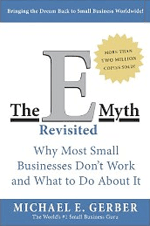
Nonetheless, EI's effect on business performance and senior employees' grandiosity highlight the need for well-executed performance management systems that measure emotional competencies. Ethical Failures The news media have highlighted numerous cases involving failed CEOs derailed by their low EI. Press coverage has prompted boards to become more sensitive to this leadership trait. You're prone to ethical failures if you overestimate your intelligence and believe you'll never get caught. Arrogance distorts your capacity to read situations accurately. In a recent Wall Street Journal article, neurosciences journalist Jonah Lehrer discusses the contradiction of power - essentially, how nice people can change when they assume positions of authority. "People in power tend to reliably overestimate their moral virtue, which leads them to stifle oversight," he writes. "They lobby against regulators, and fill corporate boards with their friends. The end result is sometimes power at its most dangerous." How to Develop EI Research by Goleman and other experts supports the view that EI can be learned, and it seems to rise with age and maturity. In 2005, TalentSmart measured the EI of 3,000 top executives in China. The Chinese leaders scored, on average, 15 points higher than American executives in self-management and relationship management. To compete globally, the United States must pay attention to emotional competencies. Developing your EI skills is not something you learn in school or by reading a book. It takes training, practice and reinforcement. The first step is measurement, through behavioral-based interviews and 360-degree feedback. Executives with little experience in receiving feedback can find this approach somewhat threatening. Try to conquer your fears, as the process brings needed attention to gaps and development opportunities. It may be best to work with an executive coach. Remember: Your emotional state and actions affect how others feel and perform. This trickle-down effect contributes to - or sabotages - your organization's well-being Upcoming Classes at the ILCTExpand Your Business and Deepen Your Coaching Skills - Register for Upcoming Classes at ILCTVIEW OUR CURRENT LIST OF CLASSES Flexible payment plans are available. Call 800-961-3424 for details. Book RecommendationsThe E-Myth Revisited: Why Most Small Businesses Don't Work and What to Do About It by Michael E. Gerber
| |||||||||||||||||||||||||
  |
|||||||||||||||||||||||||
|
|||||||||||||||||||||||||